The book reviews below were sent to me by Kent Benson, a wine educator based in St. Cloud, Minnesota. You can learn more about Kent and the subject of wine by visiting his website here.
When Kent wrote to me to suggest posting this article he named it “Regional Essentials”, being a suggested list of books for those who want to find the definitive book on each region. Neither Kent nor I are specifically recommending any of these as being the definitive book on any region and the reviews are simply a suggestion from Kent, based on his own experience, of where the search for such a book could begin.
I hope you enjoy Kent’s reviews and suggestions.
_________________________________
Regional Essentials, by Kent Benson
FRANCE
Bordeaux
The Complete Bordeaux: The wines, the châteaux, the people; Stephen Brook; Mitchell Beazley, 2007. Brook has created a comprehensive treatment of the wines of Bordeaux and the people who make them. Geographically organized, the book consists mostly of detailed profiles of the major châteaux. While it is primarily text, there are two sections of color photographs and 16 serviceable maps. It’s widely available.
Burgundy
The Wines of Burgundy; Clive Coates, MW; University of California Press, 2008. Coates covers Chablis, Côte d’Or, and Côte Chalonnaise. Each vineyard area is discussed in some detail and short profiles of its primary growers are provided. It’s very broad and exhaustive in scope, without extensive detail on any one vineyard or domaine. There are no pictures or illustrations, but there are 39 fantastic maps. There are reviews of vintages going back to 1959. It’s widely available.
Inside Burgundy: The vineyards, the wine & the people; Jasper Morris, MW; BB&R Press, 2010. Morris covers Chablis, Côte d’Or, Côtes Chalonnaise, the Mâconnais, and most other minor appellations. He begins with history, geography, climate, grapes, viticulture, and wine making. The remainder is organized very much like Clive Coates’ treatment except with a bit more emphasis on the growers – the profiles are fewer in number, but more space is dedicated to the most prominent ones. There are no pictures or illustrations, but 36 extraordinary maps. Vintage reviews go back to 1945. It’s available only through BB&R in Europe and Sotheby’s in the US.
The Great Domaines of Burgundy: A Guide to the Finest Wine Producers of the Côte d’Or; Remington Norman and Charles Taylor, MW; Sterling, 2010, 3rd Edition. There are over 140 in-depth, one to two-page profiles of the great domains of the Côte d’Or, each one with beautiful photography. Excellent maps and overviews precede each major appellation. There are vintage reviews back to 1971. It’s widely available.
Grand Cru: The Great Wines of Burgundy through the Perspective of Its Finest Vineyards; Remington Norman; Sterling 2010. The vineyards are the stars here. After a fairly extensive history, each Grand Cru and the finest Premiers Crus are discussed in detail and accompanied by luscious photographs and fascinating satellite views. Additional pertinent topics are covered as a bonus: grapes, climate, viticulture, winemaking, buying tips, and pairing guidance. It’s widely available.
The Pearl of the Côte: The Great Wines of Vosne-Romanée; Allen D. Meadows; Burghound Books, 2010. Everything you’ll ever want to know about the world’s most prestigious vineyard area. It begins with a thorough history of Burgundy followed by incredible, in-depth treatments of the wines, the producers and the history of each vineyard of Vosne-Romanée and adjacent Flagey-Echézeaux. There are only a couple of maps, but many exceptional pictures and charts. Tasting notes on vintages as far back as the late 1800s follow each vineyard section. It’s only available at BurgHoundBooks.com.
Rhône
The Wines of the Northern Rhône; John Livingstone-Learmonth; University of California Press, 2005. This is a comprehensive look at the AOCs of the Northern Rhône, from Côte-Rôtie to St.-Péray. After a general introduction to the area’s history, geography, soils, grapes, climate, and winemaking, each AOC is covered in great detail, including extensive profiles of the producers, their vinification techniques and the resulting wines. There are 8 simple, grayscale maps and there is a smattering of black and white pictures of producers. It’s widely available.
The Châteauneuf-du-Pape Wine Book; Harry Karis; Kavino, 2009. This is an exquisitely designed book, packed full of gorgeous photographs, useful charts and illustrations, and beautifully executed maps. It begins with entire chapters dedicated to history, geography, geology, Climate, viticulture, and winemaking. The bulk of the book is reserved for winemaker profiles. The attention to detail is incredible. It closes with vintage charts, a food & wine section, and a visitor’s guide. This book is pure pleasure to read or just to peruse. It’s widely available.
Champagne
World Encyclopedia of Champagne & Sparkling Wine, Revised and Updated Edition; Tom Stevenson; Wine Appreciation Guild, 2003. This is the definitive Sparkling wine Bible. The introduction covers history, production methods, styles, storage, serving, glasses, soil, and climate. The following sections progress country by country beginning with France and Champagne. The focus is on the producers, each one garnering a brief to elaborate profile, depending upon its significance. Each is given a relative quality score; some are identified as particular values; and many display a sample label. While Champagne dominates, no country is overlooked or glossed over. Photographs, charts, and maps abound. Currently out of print, a fully revised edition is due out in 2012.
The Finest Wines of Champagne: A Guide to the Best Cuvées, Houses, and Growers; Michaels Edwards, University of California Press, 2009. An introduction covers history, viticulture and winemaking. The main section consists of thorough profiles of the most prestigious houses and grower/producers. Organized by sub-region, each profile section is preceded by a map and a discussion of the prominent villages. The Côte de Sézanne sub-region is not surprisingly ignored. There are plenty of photographs, especially of producers. It’s widely available.
ITALY
Vino Italiano: The Regional Wines of Italy; Joseph Bastianich & David Lynch; Clarkson Potter, 2002. Part I covers a very brief history, laws, and grapes. The meat is in Part II, where each of the 20 regions of Italy is profiled, with a map, a discussion of the various wine styles, and charts of statistics, grape varieties, touring tips, and pairing suggestions. Each regional section ends with recipes by Joseph Bastianich and Mario Batali. Part III includes a glossary, an extensive treatment of grape varieties, an extremely useful appellation directory, and thumbnail sketches of over 700 producers. Unfortunately, the maps could be better and the few black and white photographs don’t add much interest. It’s widely available.
SPAIN
The Finest Wines of Rioja and Northwest Spain: A Regional Guide to the Best Producers and Their Wines; Jesús Barquín, Luis Gutiérrez, and Víctor de la Serna; University of California Press, 2011. A well-executed introduction covers history, geography, soils, climate, grapes, viticulture, and winemaking. The remainder focuses on the producers. Areas covered are Rioja, Navarra, Bierzo, Galicia, Basque Country, and Cantabrian Coast. Each section begins with an introduction to the region and fantastic maps. The in-depth producer profiles that follow are accompanied by beautiful portrait photography. It’s widely available.
AMERICA
The Great Wines of America: The Top Forty Vintners, Vineyards, and Vintages; Paul Lukacs; W. W. Norton, 2005. This is not a comprehensive survey of American wines. Rather, it is an in-depth survey of forty of America’s great wines, as determined by Mr. Lukacs. The distribution by state is California (29), Washington (3), Oregon (3), New York (2), Missouri (1), Michigan (1), and Virginia (1). While each chapter features a specific wine, much space is dedicated to the producers and the source vineyards. Black and white maps, portraits, and labels accompany each chapter. It’s widely available.
CHILE
The Wines of Chile; Peter Richards; Mitchell Beazley, 2006. One of the only books to focus on Chile. After a brief introduction, which includes history, viticulture, grapes, and winemaking, each of 10 wine growing areas is covered. Each area is discussed in detail and a small number of select producers are profiled. A unique section on Chilean pronunciation is a welcome surprise and one I wish more authors would emulate. There are ten decent black and white maps, but no photographs. Currently, it’s only available for Kindle and from independent sellers at very steep prices.
MADEIRA
Madeira: The Island Vineyard; Noël Cossart; Expanded Second Edition with New Material by Emanuel Berk; The Rare Wine Co., 2011. The format of this book is unconventional, with history interwoven throughout. Originally published in 1991, it has been updated and expanded by Emauel Berk with new material such as a biography of Cossart. The numerous chapters cover geography, grapes, viticulture, winemaking, types of Madeira, soleras, food pairings with recipes, auctions, profiles of 17 merchants, and vintage notes from 1863-1981. There are 3 maps and many black and white photographs. Available from amazon.com. For the best deal in the US, visit RareWineCo.com.
Kent Benson
Certified Wine Educator
Wine Location Specialist
St. Cloud, MN USA
swirl@charter.net
 The majority of this treatise focuses on the adulteration of various foods but it contains a long chapter on the adulteration of various wines, including Port wine. A very interesting read.

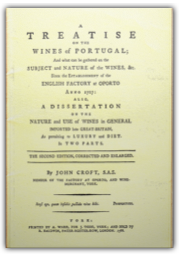 This copy is an unpublished facsimile of the 1788 edition, very kindly given to me by Isaac Oelgart.
 This is a facsimile reprint of the 1788 second edition, which was published under the full title: “A Treatise on the Wines of Portugal; and what can be gathered on the subject and nature of the wines, &c. since the establishment of the English Factory at Oporto, anno 1727. Also, a dissertation on the nature and use of wines in general, imported into Great Britain, as pertaining to luxury and diet. By John Croft, S.A.S., Member of the Factory at Oporto, and wine-merchant, York.”